|
Distance Sampling Modelling |
Presented by StatMathComp Consulting by Schwarz, Inc |
Carl James Schwarz
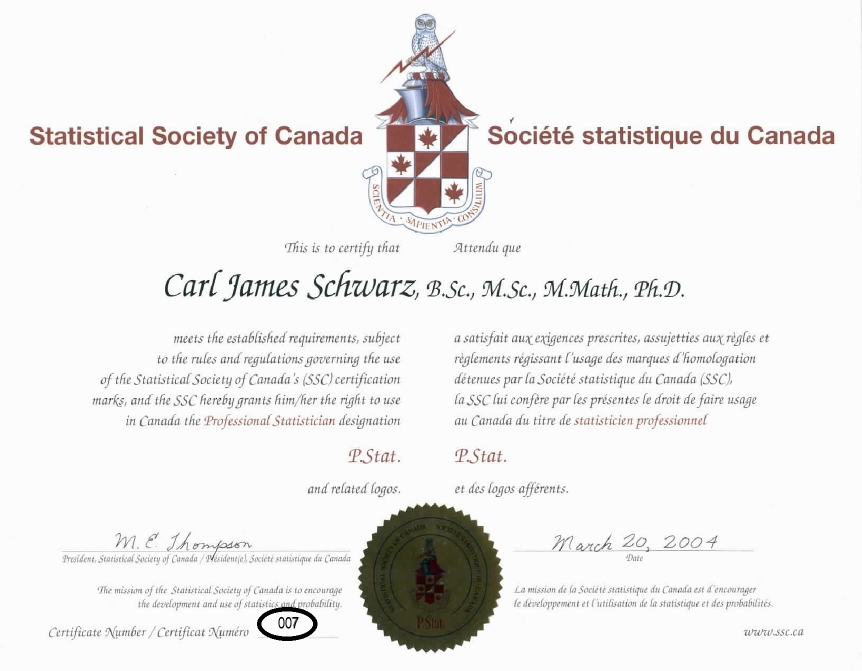
Fellow of the American Statistical Association Accredited Professional Statistician P.Stat. (Statistical Society of Canada), PStat® (American Statistical Association) |
The concepts of distance sampling will be explained and the assumptions of the methods discussed. Although the basic theory will be covered, the focus of the course will be on practical application of the methods.
The course will start with an introduction to wildlife population assessment methods, and demonstration of how line and point transect methods are generalizations of sample count methods (strip counts and point counts respectively). The underlying theory and assumptions of both line and point transect sampling will be covered, and the relative merits of the two approaches in different circumstances discussed.
More complex issues will then be covered. Special methods are required when animals occur in groups or "clusters". For example, size bias can occur - large clusters have a higher probability of detection than small clusters, so that population size is overestimated. Methods for adjusting for this bias will be given. Another issue is stratification, which is used to improve the precision of estimates when animal abundance, detection probability or clustering varies over time or space. Good survey design is an essential ingredient of a successful survey so design issues and field methods will be covered in detail. Some specialized applications of distance sampling such as cue counting, trapping webs, and indirect counts (e.g., dung or nests) will be mentioned.
A nice introduction is found at this article in Significance magazine
DISTANCE 6.0
This program is available at no charge from from http://www.ruwpa.st-and.ac.uk/distance/.
If you want to make use of the density surface modelling (DSM-not covered in this course) or mark-recapture distance
sampling (MRDS) analysis engines, you need to have the free statistics software R
installed on your computer. Consult the DISTANCE web site for details.
Mac users - The program DISTANCE only runs on Windows platforms.
So Mac users need to install a virtualization program (e.g. VirtualBox or BootCamp),
install Windows on the virtual machine, and then the Mac looks like a Windows machine.
(I'm an avid Mac user; ask me if you run into problems!)
Slides from the course are available in this directory.
Additional documentation available here
A typical course outline