|
Nest Survival Modelling |
Presented by StatMathComp Consulting by Schwarz, Inc |
Carl James Schwarz
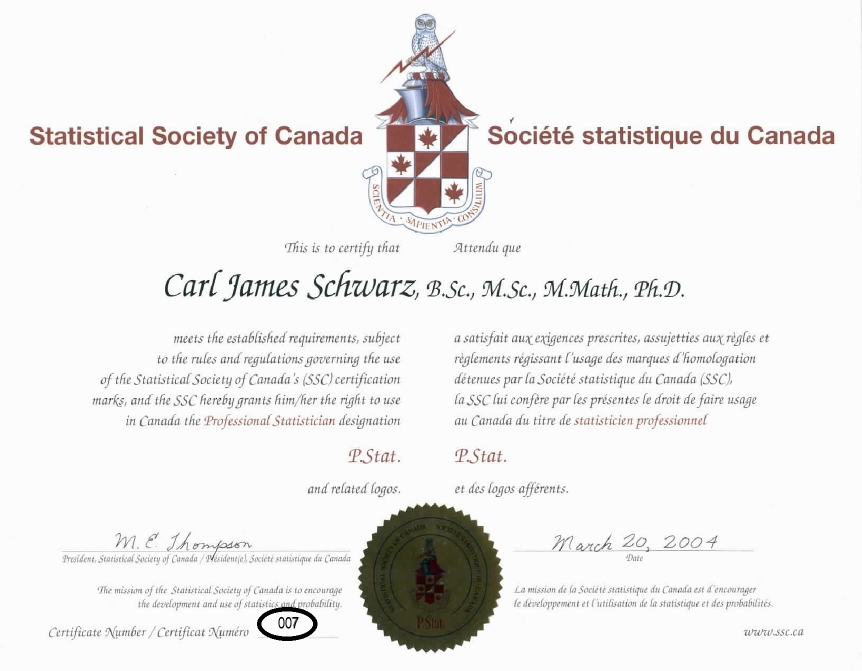
Fellow of the American Statistical Association Accredited Professional Statistician P.Stat. (Statistical Society of Canada), PStat® (American Statistical Association) |
Proper estimation of nest survival rates is critical for understanding many topics that are the focus of avian ecologists, yet the methods for obtaining such estimates are varied and can be challenging to learn. Moreover, survival analyses require different assumptions and considerations relative to other types of modeling approaches that are commonplace in avian ecology. In this workshop, we will focus on training participants in modern statistical approaches for quantifying survival during two important periods of the annual cycle of birds: the nest cycle, and the post-fledgling period.
Two influential papers are Mayfield (1961, 1975) where he introduced the method to estimate nest success accounting for the unequal probability of detection of failed and successful nests. A major dilemma with the Mayfield method is that it cannot be used to build models that rigorously assess the importance of a wide range of biological factors that affect nest survival, nor can it be used to compare competing models. Many novel and powerful analytical methods to isolate factors influencing nest survivorship were introduced in the last several years.
Workshop participants will receive hands-on instruction regarding two distinct modeling approaches important to avian ecologists. In the first half of the course, modern approaches to developing and testing nest survival models will be taught using Program MARK and RMark, in addition to logistic exposure models in R.
In the second half, survival analyses with Cox Proportional Hazards models will be taught, including instruction on the use fixed and time-varying covariates and approaches for dealing with censoring, again using R. Within each component, discussion of common study design considerations (e.g., sample sizes, sampling frequency) will be included, and participants will have time to work through their own datasets.
A nice introduction to monitoring nests is found at: Nest Watch
| Package | Url |
|---|---|
| MARK RMark |
MARK is a standalong Windoze program for capture-recapture, occupancy, and other studies.
RMark is an R packages available from CRAN that calls MARK and collects the output for further processing by R. Because RMark calls MARK directly, it only runs under Windoze. |
| JAGS | A program to run Bayesian models written in BUGS. Commonly called from R to handle input/output. |
| R Rstudio |
Download fom the usual sources RPresence, RMark, unmarked, and JAGS use R extensively. |
Slides for the course are available here
A typical course outline
Additional software to expand data to individual days is avaialble
| Example and data |
Notes | RMark | Logistic Exposure |
Cox PH | Bayesian |
|---|---|---|---|---|---|
| Hawaii Elepaio | Banko et al (2019) Nest categorical and continuous covariates |
RMark | Logistic Exposure |
||
| Killdeer | Ships with MARK Small number of nests; no covariates. |
RMark | Logistic Exposure |
Cox Prop Hazard |
JAGS |
| Mallards | Ships with MARK and Rmark. Categorical and continuous covariates |
RMark | Logistic Exposure |
Cox Prop Hazard |
JAGS |
| Redstarts | Sherry et al (2015) Categorical and continuous covariates |
RMark | Logistic Exposure |
Cox Prop Hazard |
JAGS Includes random effect models |
| Vesper sparrow | Unknown blog post Continuous covariates | Logistic Exposure |